Over the past decade, a steady drumbeat of housing studies—from Yavapai County and the Verde Valley to Prescott Valley, Prescott, and the State of Arizona—have reached a remarkably consistent conclusion: housing costs have risen faster than incomes, and the types of homes being built no longer address the needs of the people who live and work here.
One of the most recent reports, “The 2024 State of Housing in Arizona” by Arizona State University’s Morrison Institute, places Yavapai County squarely within a broader statewide crisis. Rapid growth, limited land served by infrastructure and rising construction costs have produced a severe shortage of housing, especially rentals, that everyday residents can afford.
These reports have been essential for establishing the facts, defining the scope of the problem, and identifying potential solutions. In response, Yavapai College is moving forward with piloting some of these concepts to support its students and its workforce.
Since its inception in 1968, Yavapai College has provided student housing with traditional residence halls on its Prescott campus. Think of a residence hall as a bridge between living at home and full independence. These are accommodations typically provided for recent high school graduates who will learn to live independently, with the guidance of professional and peer staff, and with a meal plan from the cafeteria. These living arrangements bring residents closer to classrooms, offices, and campus resources—both literally and figuratively.
Over time, however, the demographics of the student body have changed.
“At Yavapai College, we serve both traditional students aged 18–21 and non-traditional students of all ages—including working adults, single parents, young families, and returning learners in their 30s, 40s, and beyond,” Director of Strategic Initiatives and Special Projects Ivonne Zuniga said. A 2020 study commissioned by Yavapai College found that many of these non-traditional students indicated they would appreciate and take advantage of college housing options that afforded more autonomy and more privacy.
Simultaneously over the past several years, Yavapai College has experienced several failed searches in which candidates for employment declined job offers due to the cost of living, or accepted the position but left within a year when they found that they could not find attainable housing.
“In a region where housing costs are extremely high, offering attainable workforce housing strengthens recruitment, supports employee stability, benefiting both our people and the institution,” Zuniga said.
After extensive research, Yavapai College has responded by piloting several attainable housing solutions. They began with a small RV Park at its Verde Valley campus in Clarkdale. Students and employees may rent one of 10 RV pads if they own their own unit, or they may rent one of the college’s four travel trailers. Denser housing—that is, units per acre—was one of the solutions recommended in the housing studies.
Next, Yavapai College purchased a summer camp in Prescott and renovated it into year-round housing. The Prescott Pines at Yavapai College can accommodate 88 students and 11 employees with their families.
What were originally bunkhouses (bedrooms with bathrooms) have now been converted into small apartments with kitchens to allow for independent living. There are also 10 RV pads which can be used for students or employees. The buildings had originally been constructed over a 50-year timespan, but primarily in the 1950’s when houses were more modest in size, another recommendation from the housing studies.
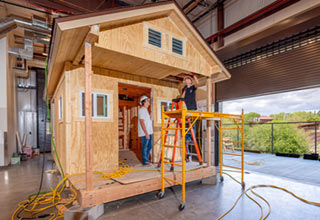
In recent years, Yavapai College has worked with its own construction training programs to build tiny homes. College students in carpentry, plumbing, and electrical classes now work together to construct the 300-square foot homes that will be installed at college locations for residential use by college employees or possibly students. The first 10 are being installed this semester, with five being installed at the Verde Valley campus and five more at the Chino Valley Center. Based on the success of the RV pads at the Pines camp and the Verde Valley campus, the college has created 16 RV pads at the Chino Valley Center as well.
The final approved housing project at the college is two houses being constructed at the Verde Valley campus for shared use by 24 students.
Yavapai College is redefining what campus life looks like in Northern Arizona by offering a range of innovative, attainable housing options for students and employees across Yavapai County. With traditional residence halls in Prescott, RV and tiny home communities in Chino Valley, apartment-style living in Groom Creek, and RVs, tiny homes, and apartments in the Verde Valley, Yavapai College is intentionally creating spaces that support access for students and added stability for the workforce and connection to the community.
In addition to meeting the needs of students and workforce, Yavapai College’s efforts demonstrate practical solutions to the housing crisis that is affecting Yavapai County and beyond. These innovative solutions allow the college to offer housing at HUD Fair Market Rates, which are roughly 10% below standard market rates.
Yavapai College operates seven campuses and centers throughout Yavapai County and offers over 100 degrees and certificates, four baccalaureate degrees, student and community services, and cultural events and activities.